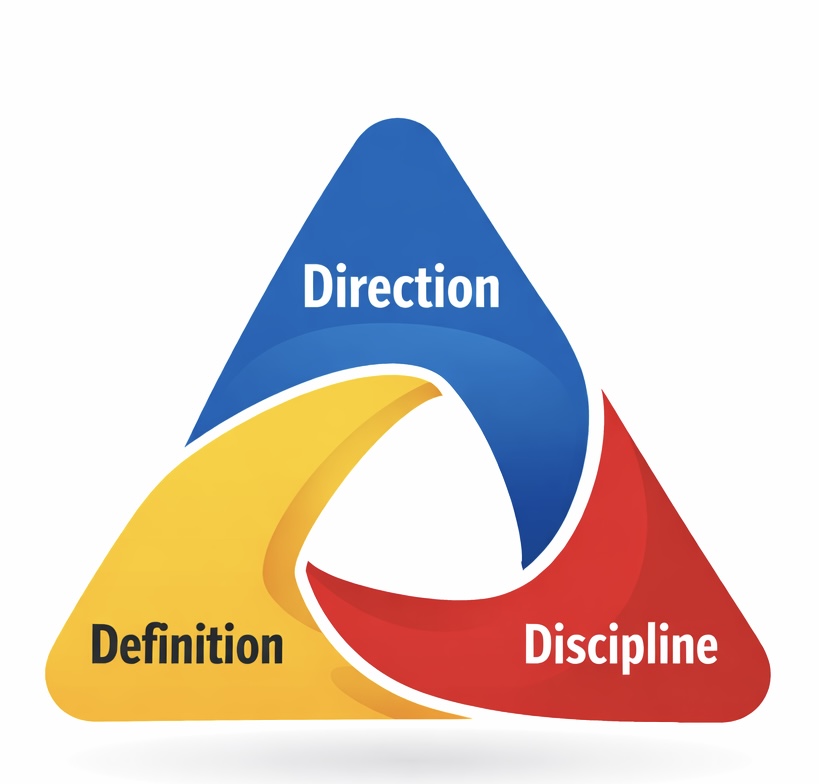
In software development, much of the challenges surrounding getting true commitment from a team can be traced back to one root cause: unclear or unconvincing goals. While most teams operate within structured frameworks like sprints or milestones the mere presence of these constructs does not guarantee alignment or effectiveness. What matters is whether the goals within those layers are clear, realistic and most importantly, collectively believed in.
A strong delivery output depends on coherence across multiple horizons.
For example:
- Short term (sprint goals)
What are we achieving this iteration? - Medium term (milestones)
How do a set of sprints come together into meaningful increments? - Long term (project deadline)
What is the ultimate outcome and what defines success?
When these layers are explicitly defined and internally consistent, they create a stable frame of reference. This empowers a team so it can reason about its priorities, make trade-offs and avoid the constant re-evaluation that erodes focus and confidence.
Believability drives output
There is a critical distinction between goals that are assigned and goals that are believed in. A team may accept a sprint scope because it fits within a nominal capacity model, but still lack conviction that it is achievable. This gap between theoretical planning and practical belief is where delivery starts to degrade.
Concrete, well-scoped goals close that gap. They give the team something tangible to commit to, not just in planning ceremonies, but in day-to-day execution. When a goal is clear and realistic, it naturally triggers the next question: How are we going to achieve this?
This shift in mind-set, from passive acceptance to active problem-solving is what actually improves output. Teams begin to anticipate obstacles, distribute work more intentionally and collaborate with purpose instead of necessity.
From abstract capacity to real strengths
Consider a team that is struggling with internal differences:
- Some members prefer working independently, others thrive in collaboration.
- Skill levels and domain knowledge are unevenly distributed.
- Some approach problems analytically, designing upfront; others prefer hands-on iteration.
In a purely abstract planning model based on story points these differences are likely to be flattened. Work is divided into uniform units, assigned based on availability rather than suitability. The result is predictable: friction, delays and merely partial ownership.
Now contrast this with a goal-oriented approach.
Instead of asking, “How many points can we deliver?”, the team aligns on a concrete outcome: for example, delivering a working integration with a new external service by the end of the sprint.
From there, the conversation changes:
- The analytically inclined team member may define the integration contract and edge cases.
- The hands-on developer may prototype the connection and validate assumptions quickly.
- A collaborative pair may tackle the more uncertain parts together.
- A domain expert may focus on aligning the implementation with business rules.
The goal remains shared, but the path toward it is tailored. Work is shaped around strengths and preferences rather than forced into uniform slices. This increases not only efficiency, but also commitment. Each contributor sees a clear connection between their effort and the outcome.
Alignment beyond the team
Well-defined goals do not stop at the team boundary. They serve as the interface between the team and its stakeholders. When sprint goals connect logically to milestones and milestones to the broader deadline, external expectations become more stable and predictable.
This reduces noise: there are fewer misaligned assumptions and the team is far less susceptible to being surprised and put off-track by stakeholders that might come up with surprises like new goals, timelines or expectations.
It also works the other way around. Showing how you’re goals are aligned and consequently met, builds trust towards stakeholders, as they can see not just progress, but direction aligned with their own input and priorities.
Conclusion
Clear, realistic goals across short, medium and long-term horizons provide more than structure, they enable belief. And belief is what turns planning into execution.
By grounding work in concrete outcomes and shaping that work around the actual strengths of the team, commitment becomes natural rather than enforced. Alignment within the team and with the wider organization follows as a direct consequence.
The result is not just better delivery, but a better experience: less friction, more ownership and a shared sense of progress toward something that is both understood and achievable.