In many software teams, energy is spent where it is most visible: writing code, fixing defects, delivering increments. Sprint boards move. Pull requests are reviewed. Releases are tagged. From the outside, progress appears tangible and steady.
Yet morale in a team is rarely determined by how stories are finished. It is shaped by something less visible but far more powerful: whether the team feels in control of its journey.
At the heart of that feeling lies one simple but often neglected discipline: maintaining a clear, realistic overview of both organizational and technical challenges, and embedding them in a timeline that everyone can see and trust.
The invisible work that determines confidence
Every project contains more than functional stories. Alongside these features live architectural decisions, dependency alignments, stakeholder expectations, regulatory constraints, integration risks, procurement delays, performance uncertainties, and sometimes plain political complexity.
These elements rarely sit neatly in a sprint backlog. They often do not fit well in the format of a user story. They resist clean estimation. They evolve.
When such challenges remain implicit, discussed in fragments, scattered across meetings, or known only by a few, the team operates in partial visibility. Developers may feel productive meeting sprint goals in the short term, but the foundation beneath their work is unstable.
Eventually, one of those hidden complexities surfaces in a stakeholder review:
- “Additional work is needed to integrate with that legacy system.”
- “Compliance has new security and safety requirements.”
- “The infrastructure team cannot support that timeline.”
Suddenly, what seemed like a steady plan becomes fragile. The team feels surprised. The roadmap shifts. Trust erodes.
The issue is rarely incompetence. It is often the absence of a maintained overview that explicitly acknowledges these challenges and places them on the timeline early.
Surprises hurt morale
Software professionals accept uncertainty. They understand that not everything can be known upfront. What damages morale is not complexity itself, it is surprise without preparation.
When teams repeatedly encounter late-stage complications, several patterns emerge:
- Cynicism grows. Team members begin to assume that plans are unreliable.
- Ownership weakens. If the plan is unrealistic, why commit emotionally to it?
- Noise increases. Stakeholder discussions become reactive rather than constructive.
- Defensive behavior appears. People protect their scope instead of collaborating on the whole.
Over time, this environment erodes trust, not only in leadership, but in the collective ability to deliver in time.
Morale declines not because the work is hard, but because the path feels unstable.
The role of a maintained overview
A maintained overview serves as a shared mental model of reality.
It answers fundamental questions:
- What are the known organizational constraints?
- What technical risks are still unresolved?
- Which dependencies could influence delivery?
- What assumptions does the plan rely on?
- What topics are complex enough to require deliberate preparation?
Crucially, it does not hide these elements. It integrates them.
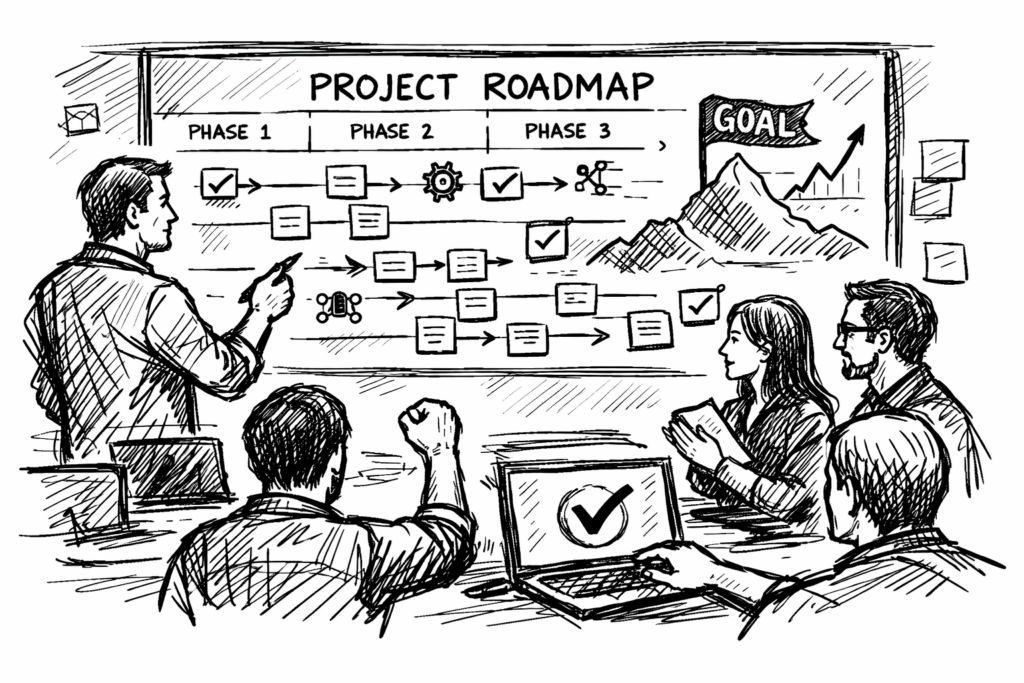
A realistic timeline is not merely a sequence of feature releases. It is a structured representation of work, risk, alignment, and uncertainty. It reflects not only what the team hopes to build, but what it must navigate.
When such an overview exists and is visible, complex stakeholder discussions stop being disruptive events. They become expected milestones in a known journey.
Trust is built on predictability
Morale is deeply connected to predictability. Not predictability in outcomes, which is very hard to achieve in software projects but predictability in process and transparency.
When a team can say:
- “We know the major challenges ahead.”
- “We have reflected them in the timeline.”
- “We understand the assumptions we are making.”
- “We have allocated space for uncertainty.”
then confidence increases.
Even if the timeline adjusts later, it adjusts from a position of shared understanding rather than shock.
This predictability fosters ownership. Teams are more willing to commit to a plan they believe is grounded in reality.
Realism shows respect
Maintaining a clear overview is not bureaucratic overhead. It is a form of respect both towards the team and for stakeholders.
For the team, it communicates:
- Your effort will not be derailed by preventable surprises.
- Your commitment is valued enough to deserve a realistic plan.
For stakeholders, it communicates:
- The project’s complexity is understood.
- Risks are not being hidden.
Respect strengthens morale because it affirms competence and shared responsibility.
Who owns the overview?
The responsibility for maintaining this overview does not necessarily belong to one formal role, but it must belong to someone.
In high-performing teams, one or more individuals take active responsibility for:
- Aggregating technical risks.
- Tracking cross-organizational dependencies.
- Challenging unrealistic sequencing.
- Ensuring the roadmap reflects reality.
- Continuously refining the timeline as information evolves.
This is not control. It is stewardship.
Without stewardship, overviews decay. Roadmaps become aspirational artifacts rather than operational tools.
Sharing the journey towards the finish
Perhaps the most important dimension is ownership of the finish.
When a team trusts its timeline, it can visualize the path to project completion. Milestones feel connected. Progress feels cumulative rather than chaotic.
Without such trust, the finish line recedes unpredictably. Each new complexity threatens to redefine the scope. Motivation weakens because effort no longer correlates clearly with outcome.
Ownership is strengthened when the team can say:
- “We know what remains.”
- “We understand the difficult parts.”
- “We have scheduled them consciously.”
- “If something changes, we will adapt transparently.”
This mindset sustains morale even under pressure.
Conclusion: Overview enables performance
Software teams thrive when they feel competent, trusted, and in control of their direction.
A clear overview of organizational and technical challenges integrated into a realistic and maintained timeline provides that control. It transforms complexity from a disruptive force into a navigable landscape.
Without it, projects drift toward surprise, noise, and distrust. Morale suffers not because the team lacks skill, but because the environment lacks stability.
With it, difficult conversations become predictable checkpoints rather than crises. Stakeholders engage with transparency. Teams commit with confidence.
In the end, the overview is not an administrative artifact. It is the quiet foundation of morale.