Retrospectives as Structural Discovery
Many teams incorporate retrospectives in their routine, far fewer teams are able to structurally learn from them. In many cases the retrospective is treated as a ritual rather than a tool to actively explore the problems holding the team back. Without a good understanding of the underlying conditions causing recurrently surfacing problems, its difficult to overcome these patterns. This causes teams to repeatedly run in the same kind of problems sprint after sprint.
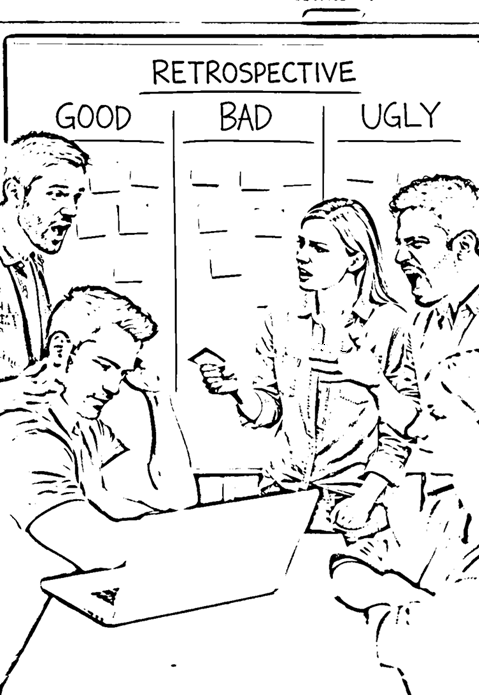
The retrospective started familiarly. Time-boxed stickies: first the good, then the bad. Three to five items per person. Efficient.
We read them out loud, adding context and examples. Then clustering began and with it, friction. Input owners hesitated as their points were merged into broader themes. Some pushed back, others elaborated, but the pressure to converge was clear. Smaller clusters meant fewer dots later, and fewer dots meant a lower chance of being discussed at all. Anything not discussed would simply disappear.
Nuance was flattened to improve voteability. Agreement came not from shared understanding, but from time pressure.
Dot voting produced a shortlist; the rest vanished remaining undocumented and unresolved. By now, time was running out. The discussion that followed felt rushed. The first acceptable solution, often voiced by the loudest person, was enough to move on.
Sure, the retrospective concluded on time.
But the room felt drained. We had produced actions, yet little clarity. The format created motion, not understanding and possibly left important issues behind.
One of the main contributors that limits effective retros may lay in traditional retro formats like the ‘Good, Bad and Ugly’ pattern. These approaches tend to reduce complex system behaviour to a set of binary labels. Combined with impromptu topic clustering and limited time to discuss individual contributions, this pushes participants towards surface-level observations. More fundamental problems may get framed as events of their symptoms rather than the underlying patterns.
“If I had an hour to solve a problem I’d spend 55 minutes thinking about the problem and 5 minutes thinking about solutions.”
— Albert Einstein
Time pressure kills insight
Developing insight requires time and careful attention to the input of all participants. A typical team may spend about 60 to 90 minutes on a retro session.
In this timeframe, they need to:
- Provide individual input
- Explain and discuss perspectives
- Discover patterns
- Come up with follow-ups or solutions
The time constraint combined with need for next-actions forces explorative discussion to compete with solution-finding. For more trivial issues this might be sufficient, but more complex impediments require multiple angles, rather than immediate closure. Finally, discovery and problem-solving are two very different cognitive modes, mixing them up weakens both.
To overcome these limitations, consider to experiment with a discovery focussed format. This will allow your team to create a shared understanding, formulate insights, patterns or hypotheses first. Solutions can come later.
Practical implications are that there is a lot more time to explore topics and add depth. The facilitator should make sure all members can provide input and intermittent discussion is limited. It’s not required to reach agreement on every issue raised, but it is important to capture the different perspectives.
Overall, the session itself should focus on:
- Identifying recurring constraints, rather than incidents
- Pin-pointing origins in- or outside the teams sphere of influence
- Identify ownership gaps
In closing
A team that understands its own system deeply, is far more efficient and autonomous no matter the challenges thrown at them.
- Structural improvement starts with structural understanding
- Retros are not about fixing everything
- Listening can be far more powerful than acting
Variety is the spice of life
You may or may not agree with the opinions voiced in this article, however, if you were to take a single point of advice: Let the ownership of your retro rotate over the members of your team. This way, everyone can get their turn focussing on what they think can help the team forward.
“Variety’s the very spice of life, that gives it all its flavour.”
— William Cowper, The Task (1785)
Rotate organizer every sprint or cycle, allow team members to choose their own focus and format. Encourage exploration and deep-dive sessions to go beyond the ritual and make continuos improvement a shared capability rather than a fixed ceremony.