There is a quiet myth in many development teams that clarity comes from role separation. The product owner defines value. The architect defines structure. Engineers build. Everyone stays in their lane. It sounds orderly. It feels efficient. And in the early stages of a team’s growth, it can even work.
But in teams composed of experienced, all-round senior engineers, this separation becomes artificial. Not because roles are unnecessary, but because maturity changes the nature of contribution. When engineers have seen multiple systems, multiple failures, multiple reorganizations, they no longer think in tasks and stories. They think in trajectories.
And trajectories are shaped long before the first line of code is written.
For example, a roadmap is not just a list of planned features. It is a statement of intent. It encodes assumptions about capacity, technical feasibility, dependencies, and sequencing. If senior engineers disengage from shaping that intent, the roadmap becomes aspirational instead of grounded.
The result is predictable: tension during delivery, “unexpected” complexity, and conversations that should have happened three months earlier.
The irony is that the people most capable of preventing this often stay silent because “we already have an architect” or “the product owner handles that.”
That silence is expensive.
Experience is systemic
A senior engineer’s experience is not limited to knowing a framework or mastering a language. It includes pattern recognition: recognizing when a seemingly simple feature introduces cross-cutting impact; when a timeline assumes stable interfaces that are anything but; when a stakeholder promise quietly accumulates technical debt.
This type of insight only has value if it is applied upstream.
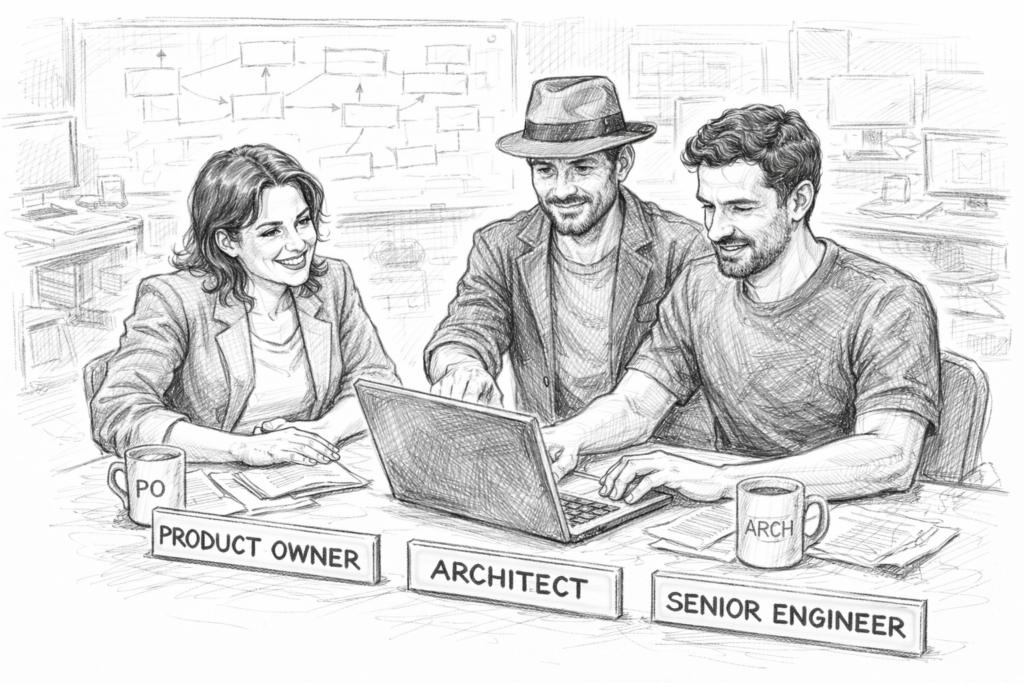
Architects cannot carry this alone. They may define and validate technical direction, but they do not necessarily have to keep track of all operational details in day-to-day implementation. Product owners maintain planning and backlog, but cannot foresee technical integration or cross-team constraints without input. They rely on engineering depth.
In the end, co-created plans are more resilient.
Shared responsibility does not dilute roles
A common concern arises: if everyone contributes to roadmap and alignment, do we blur accountability?
The answer lies in understanding the difference between ownership and authority.
The product owner remains accountable for value prioritization. The architect remains accountable for coherence. But senior engineers share ownership of outcomes, which includes engaging, questioning, contributing, and refining.
Shared responsibility distributes thinking without dissolving structure. In experienced teams, hierarchy of thought is counterproductive. Depth of thought is what matters.
When senior engineers step into alignment conversations, they are not stepping outside their role. They are exercising the full dimension of it.
Leadership without title
Technical leadership is often confused with positional authority. In reality, it manifests as initiative.
A senior engineer does not need formal designation to:
- Prepare a technical risk overview before roadmap planning.
- Suggest sequencing changes based on dependency mapping.
- Surface organizational friction affecting delivery.
- Propose alignment checkpoints with stakeholders.
None of these actions require permission. They require ownership.
In mature teams, influence is earned through clarity and consistency, not mandate. When a senior engineer consistently brings structured thinking, pragmatic risk assessment, and solution-oriented framing, the team naturally gravitates toward that leadership.
This does not compete with the architect or product owner. It complements them. Leadership emerges where responsibility is taken. And senior engineers, by virtue of their experience, are well-positioned to take it.
The maturity threshold
In junior teams, strict role separation may provide clarity. In senior teams, it can create artificial boundaries.
Experienced engineers are capable of thinking beyond immediate implementation. They understand trade-offs between short-term velocity and long-term sustainability. They can interpret stakeholder language and translate it into system implications. They can see organizational patterns, not just technical ones.
If such capability remains confined to coding tasks, the team operates below its potential. Shared strategic engagement becomes not an optional enhancement, but a natural extension of maturity.
A senior role should not ask themselves, “Is this my responsibility?” but rather “Will this improve our outcome if I engage?”
That question changes behavior. It transforms engineers from implementers into stewards. And stewardship in a team of senior professionals is not assigned. It is assumed.
In that sense, contributing to roadmaps, alignment, and structural challenges is not crossing role boundaries. It is simply the full expression of seniority.
The strongest teams are not those with the clearest job descriptions. They are those where experienced individuals step forward not to replace roles, but to reinforce them.
That step should always be available. And it rarely requires permission.